Below list of foods found in ancient Mesopotamia. Most of my information for this list comes from
The Food Timeline's section on Mesopotamia and
The Silk Road Gourmet, a blog about ancient and historical foods. Some of these would be great for making and eating with kids, others are not as kid friendly...but I included all I found just to be thorough.
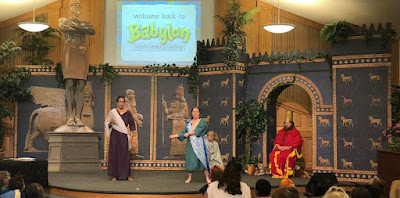
For those doing the Group VBS covering the story of the Daniel in Babylon, I've tried to include any details that might be relevant. I believe all of these were all foods eaten during the Babylonian period (assuming the older recipes would still be around later).
MEALS & RECIPES
Everyday meals probably consisted of barley paste or barleycake, accompanied by onions or a handful of beans and washed down with barley ale, but the fish that swarmed in the rivers of Mesopotamia were a not-too-rare luxury.
- Food in History, Reay Tannahill
I tried to make note of ones which were easier, or had more accessible ingredients...but included more complex dishes as well.
MEAT DISHES
Lamb With Flatbread
This recipe was concocted based on what would have been available in the time of King Darius.
Lamb with Barley and Mint (and other recipes)
This recipe (found the end of the page...just scroll down) is the easiest of the meat
recipes I've found. Easy to find ingredients too. Mint and lamb are
both strong flavors many kids aren't used to, but some kids might still
try this. There are several other recipes also listed further up but they are straight
out of ancient tablets without having been
translated for the modern stovetop, so would take some experimenting.
"Pigeon" (Cornish Hens) with Herbs
Moderately hard dish, but one I think kids might like, if they like un-breaded chicken (in fact, you could probably substitute chicken). The ingredients don't seem hard to find, except asafetida which you could substitute with garlic and onion powder (more than the amount of asafetida called for, but I'm not sure how much more--asafetida is supposed to taste pretty potent).
Kofta
This is a Persian dish, so not one of the earliest Mesopotamian dishes (probably wasn't around in ancient Sumer or Ur)...but it may have been introduced when Cyrus the Great
took over Babylon, and possibly could have been some of the fare on
Darius' table (though it may have been introduced later). The most likely candidate for the original meatball, kofta is a
dish of minced or ground beef, chicken, pork, or lamb, mixed with rice,
bulgur, or mashed lentils. Now typically fashioned into cigar-sized
cylinders, kofta seems to have originated with the Persians, who passed
it to the Arabs.
Lamb with Licorice and Juniper Berries
Neither lamb nor licorice are universally liked by children--both have rather strong tastes. However, this seems like it's a little easier than some of the other meat dishes (less steps), although there's a few ingredients that might be tricky to find (especially juniper berries). If you happen to have a Juniper bush or tree in your yard, please read this first before using any berries off it. Some types of juniper "berries" (actually, small fleshy cones) are less edible than others, and none are good in large quantities (though used as a spice in small quantities others are perfectly safe). Again, asafetida can probably be substituted with garlic and onion powder
(more than the amount of asafetida called for, but I'm not sure how much
more--asafetida is supposed to taste pretty potent). Oranges, limes or lemons can substitute for citrus.
Lamb with Licorice and Juniper Berries II
This one seems like it would take longer and be more complex than the similar recipe above, but has less unusual ingredients (save for the juniper berries).
Licorice Pork Tenderloin
Moderately hard dish. Licorice is a strong taste, so many kids won't like this. It contains some hard to find ingredients, but most of them can be substituted with commoner items (they say asafetida tastes like garlic and onion, for instance)
Wildfowl Pie
This is a very complex recipe most kids probably wouldn't even try after all that work. Has a few harder to find ingredients, mostly spices, which possibly could be left out or substituted. Cinnamon was an imported spice, so this would have be food for the well-off, not for the commoner.
Masgouf (Marinated Fish)
There is evidence that Masgouf, often considered the national dish of Iraq, was being cooked as early as 2700 BC in Mesopotamia. It was a dish that would have been eaten by common workers, not just the upper class. While today it's generally cooked with tomatoes (something they wouldn't have had), I found this recipe that does not include that. Most of the ingredients are things they would have had. They would not have had paprika, and they probably did not yet have black pepper (though pepper, which originates from India, had reached as far as Egypt by the time of Ramases II, who's mummy was found to have pepper stuffed in his nose).
Meat Broth
SOUPS AND STEWS
Babylonian Beef Stew
Mesopotamian Lamb Stew
Lamb and Carob Stew
Sounds yummy for soup lovers...but more steps than most soups/stews (and considerable time to make, which is pretty normal for soups). Carob powder will be the hardest ingredient to find--the rest are not too unusual.
OTHER DISHES
Sasqu (Porridge with Dates)
Scroll down to find this recipe. Fairly simple to make, though date syrup, which can be omitted from the recipe, may be hard to find. I think some kids would try this.
Mersu with Cheese
Pretty easy recipe, similar to the cream cheese filled dates I listed in the deserts below, but more savory/spicy, less sweet (though the dates will provide some sweetness). I haven't tried these so I'm not sure if kids would like them, but I do think kids would like the sweeter version, so it might be fun to have this too for contrast. Labnah tastes almost identical to store bought cream cheese and so cream cheese can be substituted (though labnah is fun and not too hard to make).
Mashed Turnips and Herbs
Doesn't sound hard if you have a food processor, and the ingredients are easy to find, but I'm not sure how many kids would actually try this. But on the other hand, this may well have one of the types of "vegetables" that Daniel would have been served, so it might be worth having just for that.
Roaster Barley and Herb Pilaf
Lots of steps to this, but I think at the end you'ld have something many kids would try and enjoy. It contains a few strange ingredients, some of which can be substituted or omitted. You could use garlic and onion powder for asafetida (more of it, but I'm not sure how much more, as asafetida is supposed to taste pretty potent). "Blood" can be omitted, but it's inclusion in the recipe on a Babylonian tablet shows how hard it would have been for Jews like Daniel to keep the dietary restrictions of the Law while in Babylon, since even food that were primarily made of things that were permitted might be seasoned with things that weren't, like "blood." (Genesis 9:4, Leviticus 7:26).
BREADS
Mesopotamian Wheat Bread
- Easy recipe kids would enjoy eating and making, with common ingredients. To make this more accurate though, you'd need to use something less common (emmer wheat or spelt flour would be closest to what they had, or at least a whole wheat flour of some sort).
Leavened Mesopotamian Bread - FROM SCRATCH
So, this isn't so much a recipe as a description of a trial of making leavened bread like they would have in Mesopotamia. Someone familiar with making bread might be able to use this to make their own, but it would be daunting for a novice. Still, if you are making an easier recipe using more modern ingredients, it might be a good idea to read this to get acquainted with the extra steps ancient Babylonians would have had to go through.
DESERTS
Cream Cheese Filled Dates
This is a simple recipe from a modern site, but it goes back to antiquity. You could use pistachio nuts in stead of almonds for a more "Babylonian" feel (or no nuts, which many kids would prefer). I can't speak for all kids, but I loved this as a kid (though the recipe we made at home involved rolling the cream cheese dates in sugar, in stead of adding honey to the cream cheese--but honey is more authentic).
Pistacio MersuA simple recipe for Mersu with pistachios, and a lot of historical info to go with it.
These look delicious and not too difficult.
Mersu (2nd recipe - also with fun historical info)
Mersu (3rd recipe)
Dried Apricot Mersu
3 Date Deserts
Two of these seem pretty easy, and all of them sound delicious. Ingredients are either easy to find or optional.
Cheese Mersu
These date deserts are a little more authentic than the one above, but really, cream cheese is a fine substitute for labnah, though labnah is super fun.
Palace Cake
Scroll down to find this recipe. Moderate difficulty. Many kids would try and enjoy this.
Dried Fruit Compote
Scroll down to find this recipe. Doesn't sound too hard, but I think most kids would enjoy the dried fruit more than the compote made from them, so it might not be worth the trouble.
Cuneiform Gingerbread Tablets
Not authentic, at all, but you know what, these are just too fun not to include.
CHEESE
Labneh
Labneh with Olive Oil
Labneh is a middle eastern cream cheese that may be close to what ancient Mesopotamians had. It's extremely simple and easy to make...just takes a lot of time to drain. Apart from being a little softer, it does taste very similar to store bought cream cheese though, so making it is more for the experience than the taste.
TOPPINGS/INGREDIENTS
Rose Water
This site shows how to make your own rose water several ways. If you are using roses from your own garden, please make sure that they are organic roses only (no dangerous pesticides, including fertilizer that contains pesticides). Rose water can also be found in some health stores.
Rose Water Syrup
So, I've noticed rose water in another Mesopotamian recipe, so I imagine the syrup might be just as old, and it sound really interesting. I'm not sure what it would have gone on.
MORE STRAIGHT FROM THE CUNEIFORM
Other than being translated to English, these recipes are just as the ancient Mesopotamian wrote them. In other words, it may take some experimenting to figure out cooking times and other things that were left out....but if you enjoy that sort of thing, these links will give you something to play with:
Ancient Mesopotamia Cook-off Challenge
Some of these others have already attempted, and you will find those recipes above.
An Assyrian Banquet
Some of these also have been attempted and are listed above.

Warriors swimming on inflated skins among fish.
"Over fifty different types [of fish] are mentioned in texts dating
before 2300 BC, although the number of types had diminished in Babylonian times"
--Food in History, Reay Tannahill
INGREDIENTS THEY USED
All of these were found on
The Food Timeline's section on Mesopotamia unless specifically noted or linked to another site.
MEATS
Generally, meats were either dried, smoked, or salted for safekeeping, or they were cooked by roasting, boiling, broiling, or barbecuing.
- Handbook of Life in Ancient Mesopotamia, Stephen Bertman
Various fish (over 50 kinds)
Lamb (meat of a young sheep)
Mutton (meat of an adult sheep)
Pork
Beef and Veal
- Cattle were not usually slaughtered until the end of their working lives, so the meat would be more tough and stringy.
Ducks
Pigeons
Geese
Ducks
Deer
Gazelle
Fried-fish
vendors...did a thriving trade in the narrow, winding streets of Ur.
Onions, cucumbers, freshly grilled goat, mutton and pork (not yet taboo
in the Near East) were to be had from other food stalls.
- Food in History, Reay Tannahill
DAIRY
Milk (from goats, cows, and sheep)
Cheese
Butter
Yogurt
Eggs (goose and duck)
GRAINS
Barley
- Barley paste, barley cake, bread, grain soup
Emmer Wheat
- Cakes, Bread
Millet
VEGETABLES/FUNGI
Legume Soups were a common dish
Chick peas
Lentils
Bean
Peas
Carob/Carob Seeds*
Onions
Garlic
Leek
Cucumber
Muskmelon (similar to cucumber)
Cress/Cress Seed
Mustard
Lettuce
Cabbage
Carrots
Radishes
Beets
Turnips
Truffles
Wild Tulip Bulbs - Andahsu - (or possibly wild crocus or lily bulb)
- NOT ALL TULIP BULBS ARE EDIBLE
*These were listed on The Silk Road Gourmet article Some Mesopotamian Ingredients Revealed
FRUITS & BERRIES
Fruits were often preserved in honey, and any fruit that could be dried was also dried to preserve it, as well as eaten fresh.
Dates
- Most important fruit crop in Mesopotamia
Apple
Fig
Apricots
Peaches***
Cherries
Melons
Mulberries
Pears
Plumbs
Pomegranate
Quince
Citron** (can substitute orange, lime or lemon in recipes)
Juniper Berries*
Grape
- Raisins
- One source says that grapes were rarely used.
*These were listed on The Silk Road Gourmet article Some Mesopotamian Ingredients Revealed
**Mentioned in pork recipe on ancient mesopotamian tablet
***From DK Eyewitness Books: Mesopotamia
SEEDS AND NUTS
Sesame Seeds
Pistacios
Walnuts
SPICES/SWEETENERS
King Merodach-Baladan II (721-710 BC) of Babylonia grew 64 different
species of plants in his royal garden. He kept records on how to
cultivate many spices and herbs such as cardamom, coriander, garlic,
thyme, saffron, and turmeric. The religion of Babylonia involved an
ancient medical god of the moon, who controlled medicinal plants. Potent
parts of herbs were not allowed sun exposure and were harvested by
moonlight.
- History of Spices: McCormic Spice Institute
Asafetida**
Cardamon****
Coriander
Cress
Cilantro***
Cumin
Dill***
Fennel
Fenugreek
Garlic****
Leek
Licorice**
Marjoram
Mint
Mustard
Poppy****
Rosemary
Rue
Saffron
Sea salt*
Sesame****
Silphium****
Thyme
Turmeric****
**These were listed on The Silk Road Gourmet article Some Mesopotamian Ingredients Revealed
**Mentioned in pork recipe on ancient Mesopotamian tablet
***Mentioned as Mesopotamian food in recipe for Wildfowl Pie
****Mentioned in History of Spices: McCormic Spice Institute and Tasty Bite and Cameo (it was also used as a dye...see Tasty Bite). This post has more info on dyes in Mesopotamia.
OILS
Sesame Oil****
Possibly Other Vegetable Oils
****Mentioned in History of Spices: McCormic Spice Institute
SWEETENERS
Honey
ALCOHOL
Barley Beer
Wine? (One source said grapes were rarely used)


.jpg)
_(14596552149).jpg)
